I saw a post the other day by Julien Smith (I know, it's like I'm a one-track mind lately) about how hard it is to build a following on Twitter. For relative noobs like me this was great news. However, it released a Hulk-like amount of frustration that I've just been waiting to vent about Twitter. So here we go. My top 15 Twitter pet peeves.
1. Balance is not a rule on Twitter. If you look around, most of the people who have 500,000 followers are only following 1-2 people. Conan O'Brien is a great example of this - when the Twitter "follower" feed was hacked, it became noticeable when Conan seemed to actually be following people. So what is this about, Tweet prophets? I get why you can't follow everyone who follows you, but really? 1-2% of the people following you, if that, are worth you following?
2. I was under the impression that Twitter is a social network. I think this is slightly misleading. I have encountered people on Twitter that you could retweet, tweet, mention, or whatever else all day long and they still would not give a reply back. It is called SOCIAL media, right? Deodorant and teeth brushing aren't problems, so what gives?
3. People who #talk in #hashtags for no #good reason annoy the heck out of me. Talk English. I don't speak in pound symbols. And if your sentence doesn't really have to do with any of the 20 topics you just tagged, it's not going to help you either, right?
4. I find it both creepy and irritating when someone retweets your post because of a word you used rather than because of what you actually said. I retweeted an article about how Nancy Pelosi said that her policy is based on The Word. I got "mentioned" by JesusNews. Eh?
5. A person you are following can direct message you. When you go to reply, it won't work if they aren't following you. Do you know how frustrating it can be to try to send a direct message back only to find that you, well, can't, because you're not being followed? If you're going to send me a direct message, can't you follow me?
6. The self-promotion on Twitter is terrible. I'm guilty of this one to a degree because I drive traffic to this blog using my tweets. However, I never once have said, "Come see my brilliant post." I try to lure people in to this here sticky goo based on subject matter. I find it misleading when someone tweets, "Oh, a really interesting concept" and then it's their blog. I feel cheated!
7. 9 times out of 10, logging into Twitter does not work. 'Nuff said.
8. Twitter perpetually seems like a personal cocktail party that you are eavesdropping on. I do not want to be privy to what you and your friends are planning to do, or what you and your friends did, or what you and your friends thought about what you did. Even if you're famous. Well, maybe not that last part, but still...
9. Foursqure. Oh foursquare. You are the thorn in my side, the weight on my shoulders, the...well, you get the idea. People thought tweets were banal before. Now you can find out when your contacts are working out, when they're following that up by a trip to the bar, and when they have become mayor of a furniture store. Ay caramba.
10. Trending Topics. I read an article the other day about whether Twitter had the right to remove Justin Bieber from trending topics and whether trending topics are worthwhile anyway. Short answer: no, no they're not. Right now, at this minute, four of the trending topics have hearts in them. One of those also has the word Bieber. Another trending topic right now: Ghetto Spelling Bee. Really? I mean...really?
11. The quoters are just awful on Twitter. Now some people have done a good job with it. I know a lot of people who follow "Tiny Buddha," which is a good use of Twitter. But I followed a guy for awhile and ALL he did was alternate quotes by other people with links about ex-girlfriends. Creepy. And yet his handle indicated that he would be talking about useful info. I kept waiting...
12. If you are a grammarian, you should probably avoid Twitter. I can't tell you how many tweets I see that say, "Retweet if your single" or "Their the bad guys." Move away from the computer, drop the chalupa, and learn the difference between your and you're, their, they're, and their, and many other troublesome word sets. Duhrive. Me. Crazeh.
13. How does a person with 1 tweet get 100,000 followers? This would seem to argue against Smith's case that it's hard to get followers. I remain perplexed.
14. People pretending to be celebrities. This was a major problem with Myspace. For fun, once, I followed five accounts pretending to be one of my favorite actresses. I don't think any of them noticed. It was funny. But kind of creepy. People need to get lives.
15. People who post the same thought over and over again in different ways also annoy me. Yes, I notice. I'm not living in the movie Memento. Yet. Move on to your next winning thought, please.
So there you have it. My 15 least favorite things about Twitter. What are yours?
Saturday, June 5, 2010

The downside of making your own game

But then...I got to the last few pages, which talk about "hacking" at work. And I have to raise my hand (because I can't raise my eyebrow) and say, to quote a cowboy, "Woah."
Is this realistic?
A few times at this point in the book, there have been references to the fact that both Smith and Brogan have been able to be game-changers within their various jobs. Brogan convinced his bosses that he could work outside the office and be more productive. Neither man has submitted a CV to get a job for a few years. I'm sure that all of this is true, but in the world that I live in, being a game changer is not so easy. And I think that it's important to emphasize, though it is touched upon in the book, that trying to create your own way of doing things can actually make other peoples' jobs really hard or can cause mistakes that companies previously did not have to deal with.
In my experience...
I have been on both sides of the game changing...game. Sometimes the endings are happy, but a lot of the time, a lot of bad feelings surface in the wake of the wild and crazy ship. Here are some examples.
I was training a person at a job once and going through a step-by-step process of how to accomplish a specific task. This methodology was something I had put together, which had been a bit of a game change in and of itself, but every step had a reason. The game-changer I was training kept asking if they could skip this step, or couldn't they do this and then this. I didn't want to squash the person's desire to improve a process, nor did I want to squash the person's desire to try to increase productivity, efficiency, or anything else. However, it was kind of like a toddler telling me that there was a much better way to walk now. It might be true, but till you're walking upright, I'm going to be cynical.
So it is for many scenarios within a company structure, no matter how big or small the company may be, no matter what kind of company it may be. Accounting is complicated. Production work is complicated. Media buying is complicated. Manufacturing is complicated. And it all needs to be perfect. All the time. Until you can prove that you understand all of the possible ramifications of your game-changing move, I think it's dangerous to think that rushing off to your own groundbreaking ceremony is a good idea.
I have been in the game-changer's increasingly restrictive shoes on numerous occasions as well. I have been involved in groups where I brought up ideas and was told that I was trying to fix things that weren't broken (a common retort to the game-changing attitude that Brogan & Smith don't mention). I have seen game-changers succeed but instead of earning respect, they receive snubs and stabs in the back. I have seen game-changers succeed, then leave, creating a situation where no one else can pick up where they left off. These are all risks that should be considered carefully before engaging in "job hacking."
To be fair...
Brogan and Smith do reiterate that you need to learn the rules first and that you need to be real with people. They do emphasize that anarchy, though the subject of many great songs, may not always be the best approach.
Given that, the ending of this chapter lost me a bit. As is the case with any reading experience, different things are going to resonate with different people for different reasons. However, with a fair amount of varied experiences under my belt, I would just put in a little footnote that before you try to hack your job, make sure you consider why the rules you're hacking were put in place. If you can't answer why the rules were there, you're not ready to break them.
Image credit: http://www.sxc.hu/profile/ryosugi
Friday, June 4, 2010
my Summer of reading. #1: Trust Agents

I've been making pretty good progress in watching television shows and movies that I "should really see." This Summer, I want to read as many books as possible that fall into the category of "books I should really read for my profession."
Top of the list is Trust Agents, Chris Brogan/Julien Smith, authors. I got Trust Agents, disgustingly enough, free of charge. I went to a Summit Up Conference in Dayton, Ohio last October and was lucky enough to see Mr. Brogan speak, and in my take-away bag was Trust Agents. Trust Agents was just a little baby book back then, but it has already exploded to "classic" status. I'd better get on this. As I read these "must" books, I plan on blogging whatever comes to my mind. Feel free to join in the conversation!
Blog #1: Trust Agents
I'm about halfway through chapter 2 right now, and I have to say, so far the book is reading smooth as silk (except for a typo on page 22). There is a lot one can talk about, but I want to riff ever so briefly on the topic of "voice."
Brogan & Smith talk about how amazing the first radio news broadcast must have been to people. Did they believe what they were hearing? If they did, it was probably because the voice they were hearing sounded authoritative and knowledgeable. Brogan & Smith then tie this "voice" to the game of being a trust agent.
If there's one thing I've learned from a great deal of drama from back in the day (not professional and VERY twenty-something), it's that voice in the online world is extraordinarily difficult to read correctly. As a person who tends to speak from the bottom of a tub filled with sarcasm juice, I am acutely aware of this fact. If someone doesn't know you but is reading your words, any sense of decorum you wish to bring to the exchange must reside in your words, which blink at the person from any number of machines. There is no intonation, and sometimes even emoticons don't solve all of the problems that can arise because of this "voice" issue.
The other difficult thing about voice in the online world is that we can all have multiple-personality disorder. To go back to the radio example, some of us would start out sounding like Walter Cronkite and then sort of meander over into sounding like a South Park character. This is because we converse in different ways depending on who we're talking to and where we're talking. I know a person who tweets like a moody adolescent and yet who spins pure gold in a blog. Which voice do you trust? Do you let the tweets turn you off, or does the blog lead you to look for hidden meanings in the tweeting style?
It kind of makes me wonder if we should begin to semi-formally introduce ourselves to people, even though it would never go down that way. But it would be nice to know, on the front end, whether a person's sense of humor is dry like the Sahara, potty-related, or absent. Do you get Monty Python references, or are you more a Miss Congeniality type? All of this frames out our voice, and how people read our online voice determines, I think, whether they will find us to be credible. Am I talking your language whether I mention Cartman or Friedman? Which reference makes you trust me more?
Food for thought. Can't wait to finish the rest of this second chapter!
There are times when (gasp) advertising is inappropriate

I make a few exceptions when I think it is necessary. One of the most gut-wrenching things I have ever seen was the families looking for loved ones after 9/11. Then there was the documentary that Jules and Gedeon Naudet put together. I felt obligated to watch these things.
Ever since the rig explosion in the Gulf, I've not just buried my head, but I've been covering it with some kind of mixture of mental block, a touch of denial, and maybe some concrete. I really have no stomach for suffering, and when it's animals, who have no real voice, I just can't deal with it. When it's suffering caused by greed, stupidity, and ineptitude, it's all just a little too much. However, yesterday some pictures finally surfaced of suffering birds, and I felt that sense of obligation again. This is something I need to remember. This is something I'm going to need to tell people about 50 years from now. I need to remember.
It's not just the animals
Of course, I'm not ignorant of the fact that people are already being deeply affected by what's going on here. Fishermen, the seafood industry, tourism -- tons of jobs. Suffering people on the way. Then I think about the Pointe Aux Chenes, who have born witness to American cruelty before. They were pushed to the very edges of our country, to the marshlands of Louisiana, and now, guess whose land is being soaked in the slick of greed and stupidity? And I wonder about things we aren't even talking about yet. For example:
1. How many generations must we wait till fish & seafood affected by the spill is definitely safe to eat again?
2. If the oil does indeed reach all the way up to the Atlantic, how will we possibly be able to track the effects of all of the sludge and chemicals floating out there?
3. Who will monitor these things? We can't even keep cadmium out of Shrek glasses.
Isn't there all this talk about crisis PR?
So as a marketer, I'm looking at all of this, and then I see a full page ad for BP in the Wall Street Journal. As Jay Baer points out in his brilliant Blog on the subject, the ad does not apologize. It's basically going through the motions. Now, as a media buyer and as a person rather familiar with media pricing, I happen to know that an ad like that is worth some serious change.
Maybe if the ad DID include even the slightest sense of guilt or apology, I wouldn't be so steamed. However, it really doesn't. So steamed I am.
There are a lot of things that could have been done with the some $50 million that BP has spent on these kind of pointless ads. Maybe they could have used the ad to ask people to donate to a special clean-up fund. Maybe they could have shared the space with the National Wildlife Federation. Maybe they could have given it to me so I could have purchased $50 million worth of dish soap to help clean up the suffocating birds. Really. That's what I would use it for right now.
Why be mad at BP?
In response to a lot of the "Boycott BP" talk out there, people are saying that BP is really, sadly, no better or worse than any other oil & gas company. And besides, boycotting the corporation will only, per usual, hurt people who are not to blame, like your local BP franchise manager. I've been trying to turn my attention to the National Wildlife Fund, who is asking people to spread the word via Social Media. Social Media which is, by the way, generally free.
I'm not saying that advertising in a crisis is bad policy. But the lesson here is that if you are, say, destroying a national treasure and an entire ecosystem at the same time, you might want to hold out on the "we're working on it" ad campaign until that money has been used to clean up the mess. In this particular case, advertising made BP's situation worse, not better.
Image from MSNBC.
Thursday, June 3, 2010
There's no ROI in Analytics

Analytics is not ROI. Or is it?
I think the definition of ROI has gotten a little bit fuzzy, and I think this is an increasingly dangerous problem. Why? Well, marketers can drive traffic to your website. Marketers can tell you how many people visited your site, what pages they visited, and if you have an e-commerce site, you can learn who bought what, too. However, a marketer can NOT force people to buy your product. And that's a really really REALLY important distinction that often gets lost in the shuffle.
Now, some companies might define "ROI" as how many clicks back to their website they receive. In that case, analytics and ROI could be synonymous. However, there might well be a disconnect between sales and marketing in that scenario. Ultimately, it's not visits to a website that pays the bills, as we all know.
The other danger in tying analytics and ROI so closely together is that even though the science of analytics is getting better and better every day, it is still very difficult to pinpoint where a sale comes from unless you actually ask. Kaushik talked about this in the webinar today. If you run ads in the same publication 2 months in a row, and the first month your traffic spikes while in the second month your traffic dives, does that mean the ad lost its power in 30 days? If your sales spike six months later, can you attribute it to randomness or the fact that people held on to your ad or your e-newsletter and thought of you when the need arose?
Analytics Sets the Table. ROI Cooks the Meal.
I like to think of analytics as if it were a butler making sure that everything is just so before a big dinner. Is your traffic strong? Is it going to the places you want it to go to? What's your bounce rate? ROI is the meal. It's the show. And while a person could analyze a cost per click for an ad campaign or an e-newsletter, ROI is not so easy. Analytics is important because it shows whether you are giving yourself a chance to get your Return on Investment. ROI is what comes after those clicks turn into customers.
ROI is just going to become more mysterious
We thought it was hard to pinpoint ROI when we were dealing with print programs, website development, and trade shows. Guess what's going to be even harder? Calculating ROI for a Social Media campaign. Here are just some of the questions involved.
1. Is my investment time? Whose time? What is that time worth? Is that time worth the same when responding to a tweet or updating a Facebook status?
2. Is my investment the salary of my brand new, shiny Social Media manager? If so, how can I determine if that person is performing well? Will it be based on likes, follows, retweets?
3. If a person buys from your company after seeing a YouTube video you had posted a year before, do you calculate that as ROI for the cost of developing that video, or is just bonus points for the new year?
Analytics will still work. You'll be able to see that person who clicked to your site from Facebook. You'll be able to track the success of your videos, too. But that ROI is just a different animal. It's wild and crazy. We need to cage it up, identify it, agree on that identification, and make it our friend. Because whether you're a marketer or VP of sales and marketing at your company, you're going to get asked to prove the success of a campaign based on the ROI. Explaining that it's a wiggly worm just isn't going to cut it. We can all agree on that.
Image credit: http://www.sxc.hu/profile/ilco
Wednesday, June 2, 2010
The Anti-Case Study
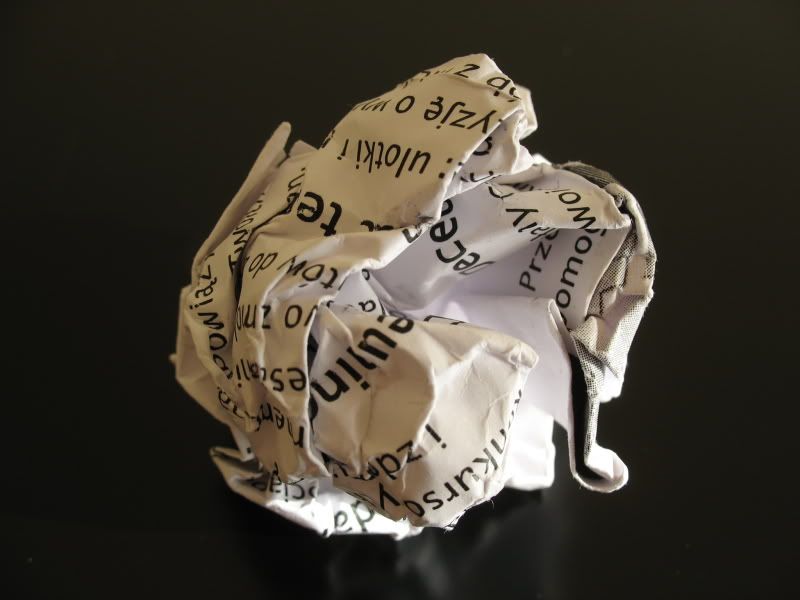
I'm not knocking this facet of the business world. Business is competitive. You need to prove you do stuff better. I get that. However, I would also toss out there that I tend to sort of skim-read testimonials and case studies. Okay, you did this, you made money, now you're telling me about it. I am very happy for you, I am humbled, nay blinded by your success and intellect. Ho-hum.
Where are the humans?
As much as a person can learn from someone else's success, I find that I tend to remember bloopers a little bit better. I mean, when you watch a television show, for example, you take for granted that everything is going to run smoothly, no one is going to forget their lines. That particular part of the project doesn't stick out. Of course it's great. These are professionals. But when you see a gag reel or bloopers? Man, that stuff sticks with me forever. It shows that the actors are human, that they are maybe of this planet. I think marketing could benefit from the same thing.
Now, there is an inherent risk in this, which is that you don't want to look dumb. But from my perspective, the world is pretty chock-full of experts who seemingly attained rock star status almost accidentally. I would love to hear about the mistakes that they learned from along the way. The bloopers.
Mistakes have legs
One of the things we preach to our clients is that case studies and testimonials have legs. You can use video testimonials as a multi-media dimension to your website or to your Social Media campaign. Testimonials are tremendous fodder for ads, e-blasts, and just about everything else. But I'm going to toss out there the idea that mistakes, or anti-case studies, could have legs, too. How? Why?
1. Mistakes are things people can easily relate to. They might be in the middle of the same exact mess you already experienced. If you can help them feel like they are not alone in their blunder AND that there is a way out, you will very likely earn their eternal admiration.
2. Admitting you can and do make mistakes makes you more credible, at least to me. I can't really relate to these experts who talk about the fact that they fell out of bed and ended up with 10,000,000 Twitter followers. But if you tell me that you started a Twitter account, had 17 followers for 5 months and then started growing your base...that I'm interested in. I want to know how you did that.
3. People are in to feeling like they are the smartest people in the world, and it's not hard to make yourself feel that way. With sites like Wikipedia and heck, with the fact that we can get people to not only LIKE us but to FOLLOW us, I think all of us are getting a bit of an ego problem. I think the idea of the case study may get overshadowed at some point by the fact that people don't necessarily want to know why what you did was great. They want to know either how to fix the one problem they can't fix or how you can help them.
Psst...the anti-case study can actually be a case study
Okay, so here's the neat part about this concept of the anti-case study. You can actually redeem yourself and create a believable, credible, realistic, easy to understand case study. Imagine, for example, if BP not only stops the oil gushing into our treasured wetlands but also manages, some centuries down the road, to redeem themselves. Wouldn't you want to know how they did that? And if they came out strong with how-to lessons on how to prevent another disaster like this, that PR would practically write itself. Become environmentalists, BP. Save the planet, save yourselves.
Tell me what you did wrong. Tell me how you fixed it. Let me use you as an example of how someone can get into a bind but then climb right out. It's a lot more interesting than retweeting a post or 5 from Mr. or Mrs. DoNoWrong.
Image by http://www.sxc.hu/profile/jarpur
Tuesday, June 1, 2010
does efficient = good?

A few hours have passed though, and one thing is kind of bothering me.
In the beginning of the webinar, Baer talks about an experience he had with the Yellow Pages. He was looking for a place that could fix his eye glasses, but when he found the listing for glasses - eye, he was directed to a list of "see also" ideas. This did not accomplish his goal. From there, the webinar segued into talking about a company's "taxonomy" and how to integrate those keywords into everything you do.
Not always, but sometimes, we are looking for information and we are not in a hurry. We are kind of open to seeing what's floating around out there. In fact, we are hoping that our exploration takes us to a really good place that we hadn't expected. And it is for these scenarios, rare though they may be, that I am pondering the following question. Does efficiency always mean good?
Maybe it's the librarian in me
I earned a Master's in Library and Information Science back in 2001, just as the online world was really beginning to explode as a source of information. There were still card catalogs at my local library and at the university library, so my education was planted squarely in between traditional and new types of research. The thing that I always thought was neat about research is that it carries you to all kinds of places if you're patient enough. Sites like Amazon, StumbeUpon, Pandora, and others cater to this adventurous desire in people to see what is related to what they know they like. Maybe people view such sites as fun. Maybe when a person is searching for your company, they don't want to have fun. They're at work or they're looking for something very specific, like a person who can fix some eye glasses.
Let me ask you a question, though. Let's say, just hypothetically, that someone started out looking for a person who could repair eye glasses. You're a company who makes those little self-help eye glass repair kits. What if that person, in skimming through the first page of Google results, sees your company's listing and decides, "Hey, I think I'll try that!" That person didn't start out by searching for a repair kit, but with some patience on his or her end and with some good SEO work for your part, it could well be a match made in heaven. Now the case is harder to argue for a more static medium like the Yellow Pages, it's true, but then again, if there was a company listed under "glasses-eye" that sold repair kits, it would be the same end result.
It all depends on what optimization means
I worry sometimes that we are becoming very 2-dimensional as far as information goes. Our thoughts are at maximum thinned out to 420 characters for Facebook. Texts and Twitter offer us less leeway. Fast sound bytes for a fast-moving society. In this kind of environment, it's easy to approach SEO the way experts like Baer recommend. Look at your mission statement. Look at how your prospects talk about you. Look at how your customers talk about you. Use those words. A lot. In a lot of different ways.
But what if society doesn't stay so linear? What if "decision engines" like Bing end up shocking the world by encouraging people to think in new ways? What if a person looking for a new bathtub ends up finding a company that can remodel the entire bathroom?
For search engines, for now, keywords are still key. But if Social Media continues to dominate the marketing world, that is going to change, I believe. Conversational, word-of-mouth marketing is going to rule the roost, and people do not talk in a linear fashion. You will not see an exchange like this, for example.
Person 1: Gosh, I really wish I could find a good contractor. I need to work on my bathroom.
Person 2: I just noticed that the following companies' websites included the words "contractor" and "bathroom." Perhaps you could try those.
No, people talk about experiences. They joke, they whine, they boast, they complain, they get angry, they get excited. Do your keywords account for a conversation that leads to your doorstep? If you're an eye glass company, are you using words like "hipster" or "emo" or "Buddy Holly?" It might seem silly, but these are the kinds of non-linear, non-sensical words that are sharing space with your keywords. And that's happening now.
So what are we going to do about it?
Well, I don't have an answer for that one. As is so often the case when discussing the current marketing revolution, the answer would have to be revolutionary. But I have done enough research to realize that people are already searching based on Twitter keywords or Facebook status updates. I know that a search for an image of candy canes on Google can pull up some truly bizarre and unrelated results. I know that a video search for manufacturing keywords on YouTube can pull up videos by heavy metal bands. I think that part of the new taxonomy, to use Baer's terminology, is going to have to be words that you see come up again and again in the same context as your prized keywords. "Classy" along with bathroom. "Fashion" along with eye glasses. There isn't a way to buy these words on sites like Facebook and Twitter. You have to claim them through association. You have to build them into your branding and integrate them into your interwoven marketing efforts. And if you don't, someone else will, and it could very well be a customer or a competitor.
Maybe "surgeon" has nothing to do with wanting to get your glasses fixed. Maybe we are right to try to streamline how people can find us. But I think the world is going a different way. It's the long tail, it's the winding path. It might not be as easy to find exactly what we set out to find in the future, but it will be easier to find exactly what we need. Will you be there for your customers?
Image by Jenny Z. http://www.sxc.hu/profile/ohinsanity
Subscribe to:
Posts (Atom)